
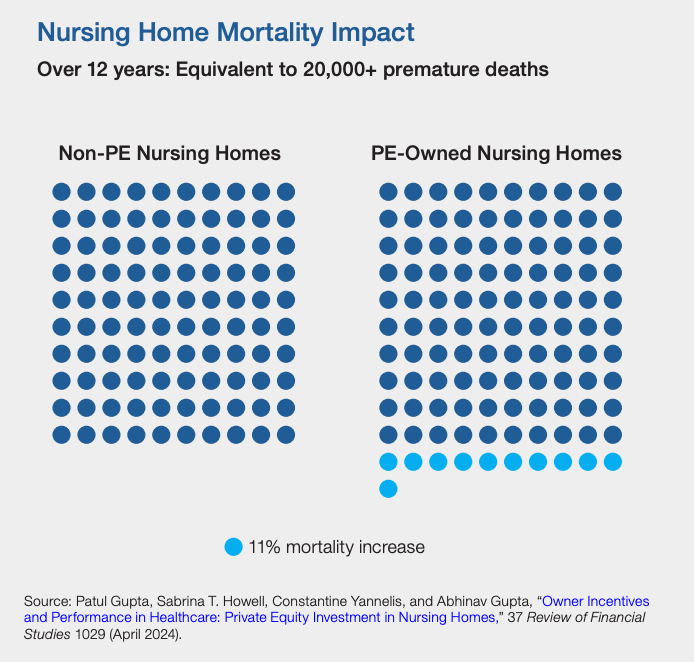
Private equity (PE) ownership is linked to 11% higher mortality rates in nursing homes, as well as 4.4% fewer nurses, 25% higher in-hospital complications and 10-times higher bankruptcy risk, with 34 health care bankruptcies in 2023 alone.
This is according to researchers at New York University’s Stern Center for Business and Human Rights, who compiled case studies of PE-owned companies, including nursing homes and health care firms, that faced bankruptcies, fraud, surprise billing, or negligence lawsuits. These case studies take a closer look into the dealings of PE firms, including Formation Capital, the private equity firm behind Consulate Healthcare and LaVie Care Centers, the latter filing for Chapter 11 bankruptcy protection in June 2024.
The report released Tuesday attributes the increase in the mortality rate to a systematic shift in operating costs away from patient care. For example, PE nursing homes were 50% more likely to use antipsychotic medication to compensate for lower staffing levels, which may have further contributed to the higher death rate, researchers noted.
PE’s extremely high debt levels were well above what regulators considered safe as well, the report found. When revenues declined, this debt burden triggered financial distress, with PE buyouts increasing the likelihood of bankruptcy from 2% to 20% over the next decade.
All said, the report doesn’t call for eliminating private equity in health care. Instead, researchers call for greater transparency of finances, ownership and care quality, while limiting excessive debt and risky practices like sale-leaseback transactions – a financial transaction in which a company sells a property it owns to a buyer and then immediately leases the property back so it can continue operating there – and debt-funded dividends.
Researchers also recommend putting in place guardrails to restrict cutting into essential services, staff and wages without regulatory approval. And, they also note that state oversight of health care acquisitions can be added or tightened to protect public interest.
To their credit, several states are weighing new limits on private equity involvement in health care, calling for stronger transaction review authority, said Michael Goldhaber, senior research scholar for the report. Goldhaber leads the Values-Based Investing program at NYU Stern’s Center.
“The Massachusetts law is a bit of a model, they included limits on sale-leasebacks. They also imposed new controlling entity liability for Medicaid and Medicare fraud,” Goldhaber told Skilled Nursing News. “Like a number of states, they strengthened the health care transaction review process which covers the acquisition of substantial health care entities including hospitals and nursing homes.”
Other recommendations included making investors liable for fraud committed by companies they control, and requiring PE firms to report financial data to regulators.
Overall, the study offers insight into how PE investment is reshaping health care, including nursing home care, and what that means for patient outcomes, hospital stability and access to care.
Private equity firms can provide capital, strategic guidance and operational improvements, but their investment model relies on high debt levels and aggressive financial practices, the report found. PE-owned nursing homes typically have very high debt-to-cash flow ratios, which leads to staff reductions and cost-cutting.
“Our health care regulators have the power to review these transactions under broad public interest criteria. We’re going to look at affordability, accessibility, and most importantly, quality of care, and we can block these deals on those grounds, or we can attach conditions to them,” Goldhaber said.
Along with strengthening transaction laws, states can use existing levers to promote best practice regulation, Goldhaber noted.
“That means putting an end to sale-leasebacks. And we’d like to see a cap put on the debt-to-cash-flow ratio, and an end to closures and cutoffs of essential services unless they can really be justified in emergency circumstances,” said Goldhaber.
A chain reaction from PE deals
Further down the line, outcomes linked to PE can result in closures and reduced health care access. Some markets are particularly vulnerable because nursing home patients lack choice, they can’t easily judge quality, and don’t pay their facility directly; Medicare or Medicaid as the middle man hurts here, allowing owners to adopt a profit-focused financial strategy to prioritize returns over care quality, according to the report.
There have been more than $1 trillion in debt-financed deals in the last decade, according to the study, as PE rapidly grew over the past two decades.
PE’s leveraged buyout business model can be seen in the $6 billion acquisition of nursing home chain HCR ManorCare by PE firm The Carlyle Group in 2007 – Carlyle recouped its money early with a $6 billion “sale-leaseback” of HCR’s real estate.
Portfolio firms are required to sell buildings they own and pay rent moving forward. The practice allows PE owners to extract value while burdening the underlying institutions with new obligations, according to the report.
“Indeed, Carlyle’s sale of HCR’s real estate left the nursing homes with debt and rent payments that proved hard to sustain after Congress cut Medicare reimbursements under the Affordable Care Act,” researchers said in the report. “As the residential elder care business hit headwinds, Carlyle lost control in 2017. HCR’s nursing homes, then numbering 1,500, fell into bankruptcy the next year amid media reports of deteriorating care quality.”
Case in point
Goldhaber put together case studies of PE-owned companies in various industries, including nursing homes and other health care sectors, that experienced bankruptcies, fraud cases, surprise billing practices or negligence lawsuits.
Such studies highlight how PE uses corporate structures and bankruptcy processes to complicate accountability and potentially harm patient care.
“These are not small enterprises that private equity is taking over … there were very large sale-leaseback transactions, which saddled the nursing homes with new rent payments that were functionally a new form of debt and weren’t sustainable,” said Goldhaber.
The report follows private equity firm Formation Capital in one example, which started acquiring nursing homes in 1999. By 2012, Formation operated nearly 200 facilities under Consulate Healthcare and LaVie Care Centers and had the largest nursing home network in Florida.
Some of Consulate’s Florida homes recorded more than 100 regulatory violations in five years, and reports indicated that the company used complex corporate structures and minimal insurance coverage for its properties.
Critics said these tactics were used to limit legal liability, an important point considering court orders in 2020 requiring Consulate affiliates to pay $250 million for Medicare overbilling. The company placed nursing homes into bankruptcy, but not before awarding its CEO $2 million in bonuses, the report found.
“The Formation Capital cases are interesting because they combine the sale-leasebacks that we see in the hospital industry with the flood of negligence lawsuits that we see in the prison health care industry,” Goldhaber said.
Bankruptcy proceedings reduced the fraud judgment by 98%, or under $5 million, and insiders regained control of the facilities.
In 2023, the U.S. Department of Justice (DOJ) said LaVie received more than $30 million in fraudulent pandemic tax credits; the operator closed or sold more than 90 nursing homes and placed the remaining 43 in bankruptcy.
Plaintiffs with negligence judgments claim LaVie shifted ownership of facilities before bankruptcy to avoid liability.
Meanwhile, serious care issues were brought up as the bankruptcy proceeded, including residents skipping meals, the report found, really underscoring “the human cost of all of this financial gamesmanship,” Goldhaber said.
The 43 facilities in bankruptcy exited proceedings and began operating under Avardis Health.
More recently, bankruptcies involving nursing home giants like 175-facility Genesis HealthCare have captured the attention of industry stakeholders.
California-based provider NewGen purchased Genesis assets for $1 billion in a bankruptcy sale earlier this year, following the failure of an insider-led bid in December, led by controlling shareholder Joel Landau and private equity firm ReGen Healthcare. That proposal would have allowed ReGen to retain control while reducing debts and malpractice claims, but creditors argued the process favored insiders.
Companies featured in this article:
Consulate Health Care, lavie care centers, New York University