The roadmap for AI use in the nursing home is set to pack a one-two punch, with deployment of tools for administrative efficiencies first on the list, as providers also plan to explore clinical applications for future long-term use.
But significant roadblocks remain, including limited interoperability between care settings and with vendors gatekeeping data. There’s also a lack of best practices in the sector which makes it difficult to establish long-term strategies, while AI changes at a quick pace.
Cascadia Healthcare, for one, is taking a multi-pronged approach to mapping out AI use, thinking about efficiencies first, then clinical integration, Cascadia President and CEO Owen Hammond said.
Cascadia’s executive team wants to make sure a building leader isn’t wasting time putting together an Excel spreadsheet on over-accruals when they can be making a difference with residents or putting together strategic initiatives, Hammond said.
The company’s AI platform can track over-accruals in the last year and create a 60-page invoice for a building leader, highlighting overcharges for review.
“I think it’ll be this kind of pressure release valve,” said Hammond. “There’s so much compression put on this industry because regulations are so much. I want to get rid of all of that.”
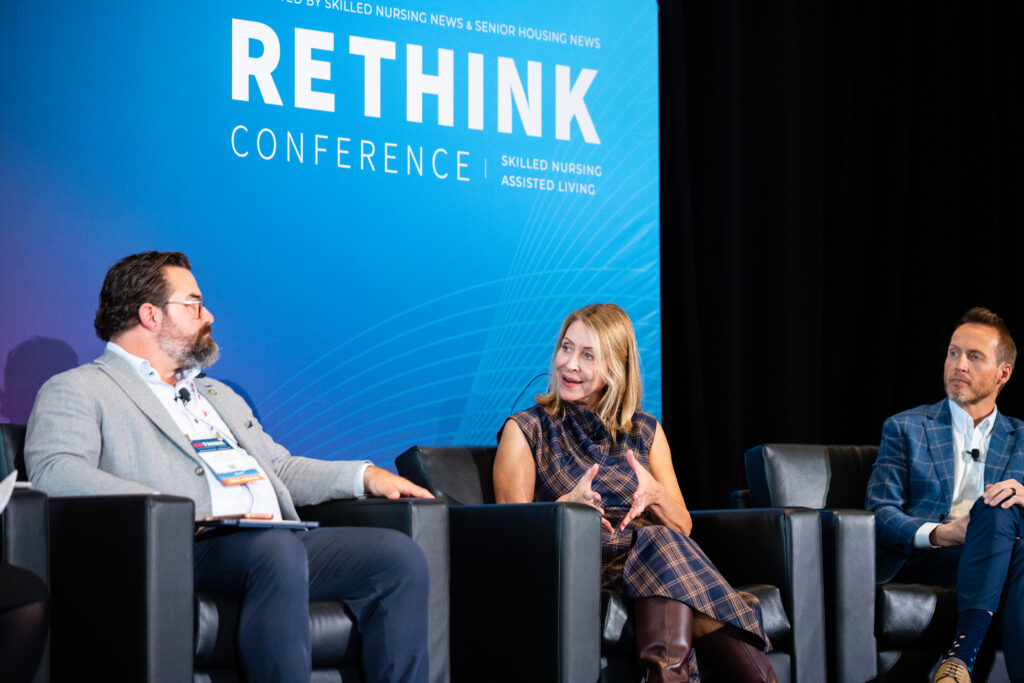
Hammond spoke about Cascadia’s AI roadmap at SNN’s RETHINK Conference last month, along with Tom McClelland, Chief Technology Officer for CarDon & Associates; and Liz Fandel, Chief Marketing and Innovation Officer at FellowshipLIFE.
What’s useful, what’s not, and what is just noise
As for AI tools in the clinical arena, Cascadia isn’t fully integrated with AI elements here but leaders are figuring out what’s useful, what’s not and what is noise.
Clinical AI use will likely revolve around preventing falls, ensuring there’s no adverse interactions with medications, and identifying residents that are lonely or depressed, Hammond said. These tools could suggest activities and interventions prior to a falls event happening.
“The advances that we’re seeing will allow us to become more strategic,” added Hammond. “We can take a lot of data that we didn’t know correlated, and we can bring them together and find out that there are things that we could do better, things that could enhance the others.”
Down the road, operators can build a system with the help of AI that tacks a resident from the skilled setting and then when they’re discharged home, ensuring the right medications are sent and there isn’t duplicate equipment.
CarDon, meanwhile, is using technology and AI internally to help the team build software.
“As a technologist who does still write code and do software development, I would say that our approach now is, how do we leverage some of the tools and the way that software developers work and bring that to the knowledge of workers,” said McClelland, referring to corporate staff, accounting staff and finance teams, MDS coordinators, and other workers interacting with portals and grabbing and analyzing data and spreadsheets.
That’s next on the docket – giving these staff members the tools of ChatGPT and Claude to build and share agents, said McClelland. AI agents are autonomous systems that can reason, plan and execute tasks instead of just autocompleting text.
“Imagine what that’s going to look like a couple years from now, or maybe nine months from now, when your accountants stop looking at spreadsheets because they no longer have to do that,” said McClelland.
CarDon is also mapping out data ownership, especially with today’s technology vendors introducing subscription services for its nursing home clients.
“They want to hold that data. They don’t make it easy for AI agents,” said McClelland. “I hope a year from now, we’re on this panel talking about how we’re using AI agents to do all of this work, not just some of it, but literally as much as we can, so that clinicians can do what clinicians do best – take care of folks.”
The frontier phase
Overall, McClelland said he’s excited for the opportunity to solve big problems and challenges with the help of AI, but there’s still a long way to go, especially when it comes to AI and interoperability between nursing homes and other care settings.
“Interoperability is a huge issue for us,” said McClelland, explaining that use of paper presents a hurdle to a more seamless exchange of information between service providers across the healthcare continuum. “People joke, but we still get faxes; it’s crazy. We still have residents that come to our doors on a Friday night with a stack of paperwork on their chest,” said McClelland.
And there are so many AI opportunities, Fandel said, and the sector as a whole hasn’t really mapped out how such tech is going to be, or should be, integrated at a care level.
As an industry, there has to be some sort of best practice when it comes to an AI roadmap for the future, she added.
“Technology is moving so fast that you might put something in place, but then it’s obsolete,” said Fandel. “By the time you gathered all the information, it was on to the next thing.”
Training staff on technology platforms also takes them away from their residents and hands-on learning, Fandel added.
When thinking about a roadmap for greater AI use, McClelland likened it to the time when the modem and email were first introduced.
“There’s this progression. There’re these leaps. I think that there will be some settling out with this. There’s this frontier mentality where people are trying to test it, figure out what it is,” McClelland said of AI use. “I think that some ‘cooler heads will prevail,’ if you will, and we will figure out collaboration.”
Companies featured in this article: