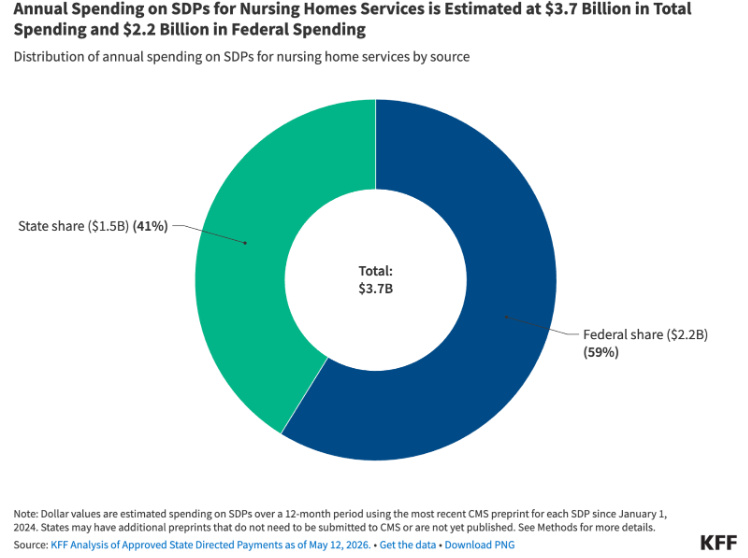
New federal limits could reduce funding for nursing home services by billions of dollars, according to an analysis published Wednesday. These payments total an estimated $3.7 billion annually, including $2.2 billion in federal funding. Potential cuts could strain nursing home finances, reduce Medicaid bed availability and limit residents’ access to care.
The 2025 federal budget reconciliation law, commonly known as OBBBA, introduces new limits on Medicaid state-directed payments (SDPs), which states use to increase payments to nursing homes and other health care providers. These payments help support nursing home services, particularly for residents covered by Medicaid.
A KFF News analysis estimates that nursing home SDPs total $3.7 billion annually, with almost 60% being federally funding. At least 15 states use these payments.
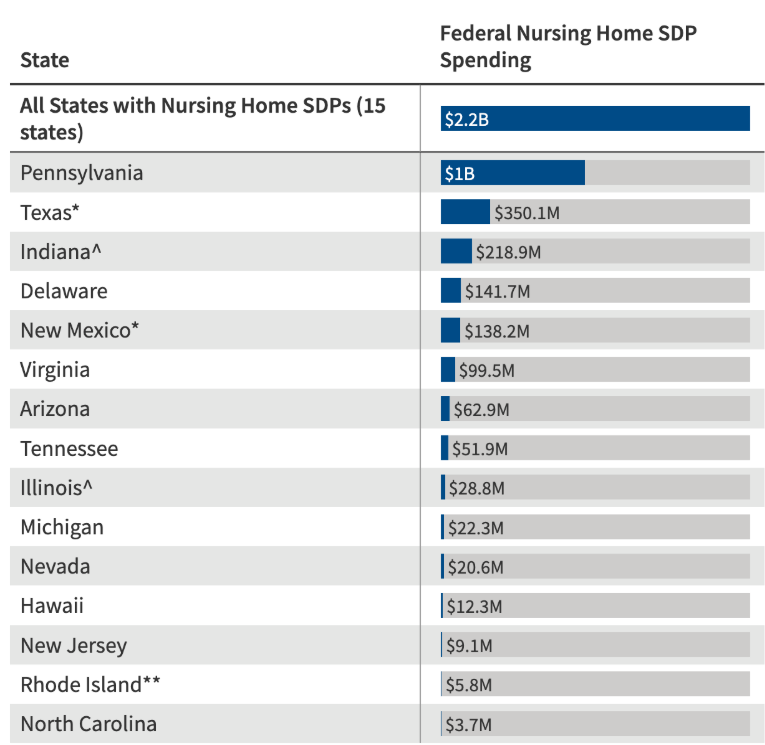
Pennsylvania accounts for the largest share of federal spending on nursing home state-directed payments in the analysis, receiving an estimated $1 billion annually, or nearly 47% of the $2.2 billion, in federal funding nationwide.
Meanwhile, Texas, New Mexico, Rhode Island, Illinois and Indiana also have payments that may be affected, although the extent remains uncertain.
While it is premature to gauge the exact impact, a reduction in such payments could weaken nursing homes’ ability to maintain services and Medicaid beds, although more detailed state-level payment data and comparisons with Medicare rates are needed to estimate the true impact, experts said.
‘Ripple effects’
“Overall, it’s still too early to determine the specific impact these changes will have on Pennsylvania’s Medicaid program or individual nursing facility providers, as much will depend on the final outcome of the proposed federal rule and how it is implemented,” President and CEO of the Pennsylvania Health Care Association told Skilled Nursing News. “That said, as proposed, the impact on Pennsylvania’s Medicaid program could be substantial, with ripple effects extending well beyond nursing facilities.”
KFF’s estimate uses Pennsylvania’s 2025 payment rate of 74.6% of average commercial rates (ACR), combining county and nonpublic facilities, he said. Meanwhile, the state’s 2026 filing separates them: 48.5% of ACR for nonpublic facilities and 97.5% for county facilities.
“This distinction is important when evaluating the potential impact on different types of nursing facility providers in Pennsylvania,” Jacobs said, adding that the final financial impact remains uncertain pending federal requirements and implementation. “While providers are certainly paying close attention to these developments, it would be premature to quantify the financial impact or speculate about specific operational changes until there is greater clarity regarding the final federal requirements.”
Zach Shamberg, chief of government affairs at Saber Healthcare Group, which has a large Pennsylvania footprint, told SNN that he was alarmed by the findings of the analysis given that Medicaid is how most nursing home residents in Pennsylvania – and across the country – pay for their care.
“Pennsylvania potentially has more at stake than any state in the country, as payments will be capped that help close the gap between what Medicaid pays and what care actually costs,” he said.
Saber Healthcare is one of the largest long-term care organizations in the country, providing back-office consulting and support services to 160 plus skilled nursing and assisted living affiliated facilities across five states – Ohio, Pennsylvania, Delaware, Virginia, and North Carolina. Saber-affiliated facilities will now care for more than 18,000 residents daily.
Federal regulators have admitted that they don’t yet know how deep these cuts will be for nursing homes, Shamberg said, but called on the Centers for Medicare and Medicaid Services (CMS) to avert any adverse impact from these issues.
“These payments are not loopholes or budget ‘gimmicks. They are federally approved, transparent payments that keep nurses and aides at the bedside for Pennsylvania’s seniors. Starting in 2028, they may begin to shrink each year,” he said. “We urge CMS to get the details right before the final rule is written, and we look forward to working with members of Congress, as well as Governor Josh Shapiro and the General Assembly in Harrisburg, to protect resident care as these changes take hold,” he said.
John Kane, senior vice president of reimbursement policy at the American Health Care Association and National Center for Assisted Living, which represents nursing homes and other long-term care, said it was too early to determine what these changes could mean for specific services and the impact could be different in each state.
“Medicaid funding is critical to nursing homes’ ability to care for residents. Changes to state-directed payments could create additional financial pressure for affected providers, but the impact will depend on each state’s payment structure and implementation,” Kane said in an emailed response. “We remain focused on supporting our state affiliates who are working closely with state Medicaid agencies, governors and state lawmakers to identify practical solutions, including opportunities to protect base Medicaid reimbursement rates and preserve access to care.”
Companies featured in this article: