As occupancy gains slow and lower-reimbursing managed care plans continue to reshape patient admissions, skilled nursing providers must focus on right-sizing occupancy rather than simply filling beds, according to CliftonLarsonAllen’s 41st Annual SNF Cost Comparison and Industry Trends Report, released Friday. The report includes managed care data for the first time.
And future profits for providers may depend less on broad industry trends and more on quality, referral relationships and operational efficiency, the CLA report concludes.
“As shorter lengths of stay increase, patient throughput requirements — more admissions, transitions, authorizations, and revenue-cycle activity — take on greater importance,” the CLA researchers stated, noting shorter stays under MA plans. “Financial sustainability increasingly depends not only on filling beds, but on efficiently moving residents through them.”
This also means that providers will be under more pressure to better address resident needs and juggle workforce and clinical capabilities with payer requirements – and strive to maintain higher star ratings.
National median occupancy reached 84.8% in 2025, and nearly half of skilled nursing facilities operated at 85% occupancy or higher, the report states. Occupancy has increased by almost 12 percentage points over five years. However, the pace of improvement slowed to 1.9 percentage points in 2025, compared with increases of 6.3 points in 2024 and 10.3 points in 2023.
About 32% of facilities still had occupancy below 75%.
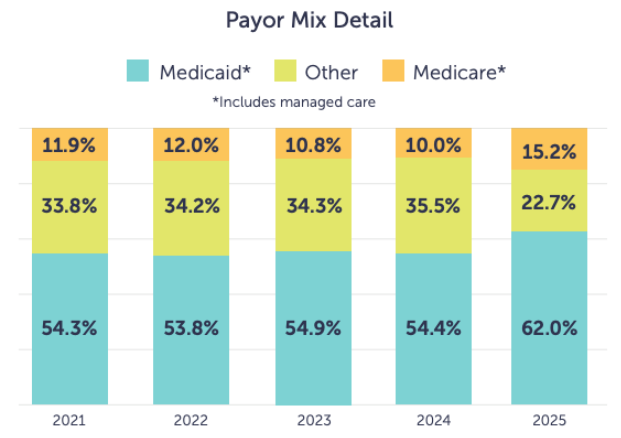
(Source: CLA’s 41st Annual SNF Cost Comparison and Industry Trends Report)
Latest CLA includes managed care data
For the first time, CLA’s report also includes managed care data as Medicare Advantage and Medicaid managed care continue to influence profits for skilled nursing providers.
More than 51% of Medicare-eligible Americans, or more than 35 million people, are enrolled in Medicare Advantage plans, while many states also use managed care in their Medicaid programs.
In the report’s 2025 data, managed care accounted for 42.3% of skilled nursing admissions, including 32.4% from Medicare Advantage and 9.4% from Medicaid managed care.
Those admissions can require different operating strategies because residents covered by Medicare Advantage generally have shorter stays than those covered by traditional Medicare. The median length of stay was 25 days for Medicare Advantage, compared with 41 days for Medicare fee-for-service, a difference of 39%, the report notes.
Median gross daily charges for Medicare Advantage were approximately 79% of those for traditional Medicare. Given the shorter stays and lower daily charges, facilities must manage patient flow carefully to maintain financial performance.
According to the report, a Medicare Advantage bed must turn over approximately 64% more frequently to generate the same number of occupied days. In other words, a facility would need about 1.6 Medicare Advantage admissions for every traditional Medicare admission to produce equivalent census.
As a result, financial sustainability increasingly depends on more than occupancy. Providers must also manage admissions, care transitions, authorizations and revenue-cycle processes efficiently while maintaining quality outcomes.
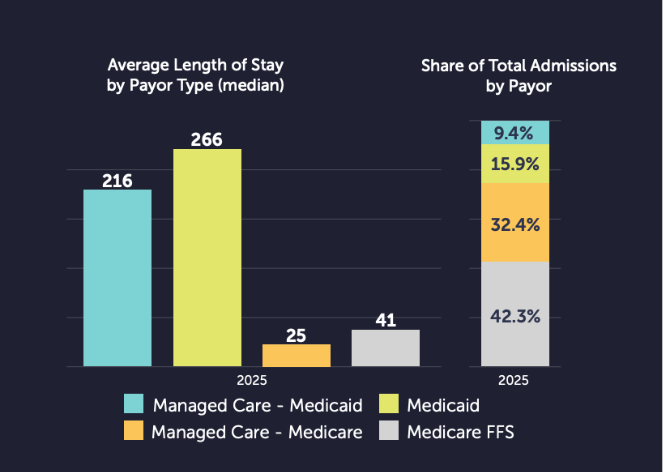
(Source: CLA’s 41st Annual SNF Cost Comparison and Industry Trends Report)
Quality of care ever more important
Quality is emerging as another significant competitive advantage. The report found that facilities with higher five-star quality ratings generally had higher occupancy, lower nurse turnover, less reliance on contract labor and stronger operating margins.
Median occupancy ranged from 77.2% at one-star facilities to 87.6% at five-star facilities. Across that same range, median Medicare fee-for-service admissions increased from 37 to 91, while Medicare Advantage admissions rose from nine to 53.
The relationship between quality and financial performance was particularly pronounced at higher ratings. Operating margins increased from 1.8% at one-star facilities to 4.7% at five-star facilities. The margin improvement was relatively modest between one- and three-star facilities, at 40 basis points, but reached 250 basis points between three- and five-star facilities.
“This year’s data shows higher 5-star quality ratings are associated with higher occupancy, lower nurse turnover, lower contract labor utilization, and differences in payer mix and operating performance. This suggests quality can serve as an economic flywheel,” the report noted.
The findings suggest a potential threshold at four stars, where improvements in quality may translate into greater access to referrals, payer networks and more favorable financial opportunities.
Quality also appears to support workforce stability. Contract labor use continued its multiyear decline, falling from a high of 10.3% in 2022 to 5.2% in 2025. Among five-star facilities, median contract labor utilization was 4%, approximately half the rate at one-star facilities, the report states.
Medicaid reimbursement and OBBBA impact
The latest CLA report also notes growing pressure on Medicaid reimbursement. Changes under the One Big Beautiful Bill Act, commonly called OBBBA, including potential effects on provider taxes, state-directed payments and Medicaid eligibility redeterminations, could create additional challenges for facilities and state budgets.
States that regularly update reimbursement rates to reflect current costs, resident acuity, staffing and quality measures may be better positioned to withstand funding pressures. States more dependent on provider taxes or state-directed payments, particularly where reimbursement rates rely on outdated cost data, could face greater challenges.
Demographic changes will add urgency to those concerns. The population age 85 and older is projected to grow by 18%, or 1.22 million people, over the next five years. All baby boomers will have reached Medicare eligibility by 2030.
At the same time, the nation’s skilled nursing bed supply is moderating, and workforce constraints could limit providers’ ability to accommodate rising demand. Growth in the population age 85 and older also varies considerably by state, ranging from 8% in Hawaii to 33.5% in Nevada over the next five years.
Meeting future demand will require facilities to retain nurses, manage increasing resident acuity and maintain sufficient staffed capacity.
The report also points to opportunities for high-quality providers through emerging value-based care arrangements, including the Transforming Episode Accountability Model, expanded joint replacement payment models and accountable care organizations. These arrangements may reward providers that help reduce hospital readmissions, emergency department visits and unnecessary utilization.
The report draws on the Centers for Medicare and Medicaid Services (CMS) cost report data from roughly 11,800 skilled nursing facilities for fiscal year 2025 — more than two-thirds of all Medicare-certified SNFs. It supplements this with Payroll Based Journal staffing data, CMS Medicare Advantage penetration reports, CMS Form 2540-24 for managed care detail, and proprietary demographic projections data.
Companies featured in this article: