

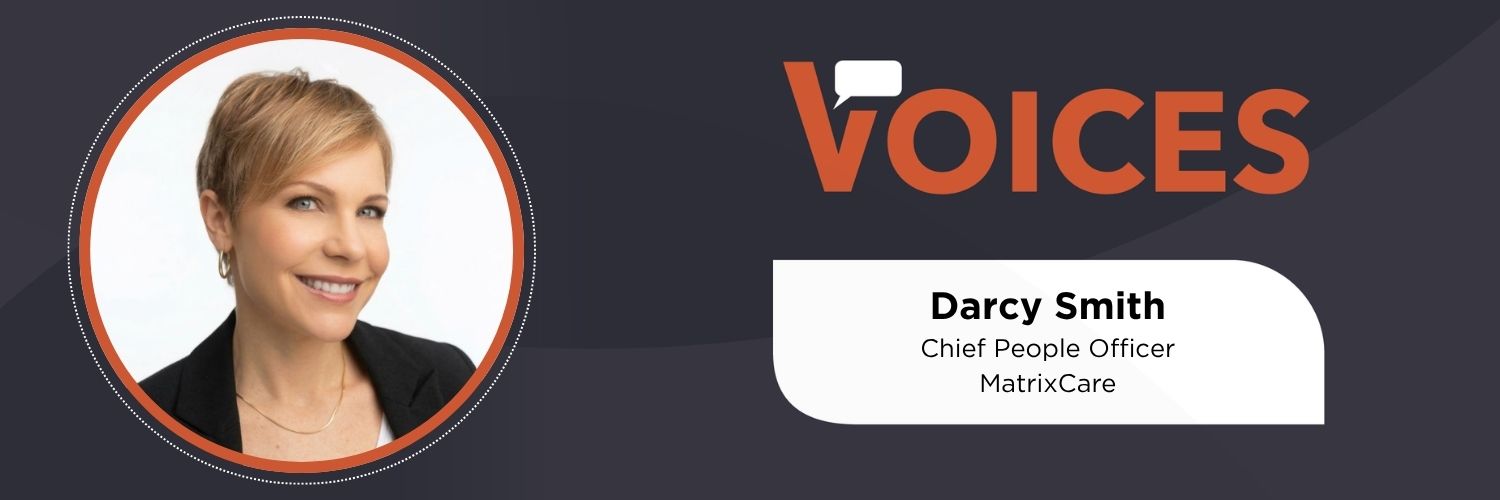


This article is sponsored by MatrixCare. Skilled nursing continues to face persistent workforce challenges around recruiting, retention, onboarding and employee engagement. But many of the factors that shape whether people join an organization, stay and do their best work extend well beyond skilled nursing. In this Voices interview, Darcy Smith, Chief People Officer at MatrixCare, brings a broader people-leadership perspective to the workforce conversation, sharing lessons from across health care, technology and other industries that skilled nursing organizations can apply to create a stronger employee experience.
Skilled Nursing News: You’ve led people strategy across health care, technology and other industries. What experiences have most shaped the way you think about creating workplaces where people want to join, stay and do their best work?
Darcy Smith: I’ve spent about 30 years in HR, roughly 20 in leadership roles, across health care and technology. I worked in e-commerce at Custom Ink and later with ambulatory surgery centers through Compass Surgical Partners, so coming to MatrixCare really brings those experiences together.
One thing I’ve learned is that it’s not about perks. Ping-pong tables and cornhole are nice, but they’re not what makes a workplace great. At MatrixCare, we call our employees teammates, and what they value is role clarity, career growth and a strong leader. Compensation and benefits matter, but those are table stakes. You have to get them right. After that, it’s about whether people understand their role, see a path forward and feel supported by their leader.
At Custom Ink, we made Fortune’s Best Workplaces lists more than once. I didn’t look at the other companies on those lists as competitors. They helped set the standard and pushed us to get better. That’s how I think about building workplaces where people genuinely want to be.
Skilled nursing has faced persistent recruiting and retention challenges for years. From your broader people-leadership perspective, where do organizations sometimes focus too narrowly on filling open positions instead of the overall employee experience?
I think a lot of organizations treat recruiting like a volume problem. We have to move faster. We have to fill these roles. I see it as a throughput problem. You can hire 100 people, but if you’re losing 90, you’ve got a leaky bucket. Some of that is the market, but you still have to ask what’s causing people to leave and what you can do differently.
Recruiting teams often get measured on time to fill and the number of requisitions they’ve closed. Those matter, but so do retention and quality of hire. I hold my talent acquisition team accountable for both speed and quality, and frankly, I’d rather have quality. I want people who fit the organization and are going to stay.
That means talent acquisition can’t just be an operational function where someone says, “Here are the openings. Go fill them.” They need to be strategic business partners. When I’m building that team, I look for people who are curious, sharp and genuinely care about bringing in good talent. I set that expectation during hiring, then reinforce it through our KPIs. Along with time to fill, I track what I call our “A-player hire rate.” It’s about keeping the focus on the right people, not just filled positions. That’s how you start fixing the leaky bucket.
How important is onboarding in shaping that experience, and what can organizations do early in an employee’s journey to create a stronger foundation for engagement and retention?
First impressions really matter, and they start before someone is hired. How are you following through with candidates? Are you keeping them updated and treating them like human beings? I come back to the golden rule. How would you want to be treated?
Then, on day one, do they have the right logins and tools? It sounds tactical, but a rocky start shapes how someone feels about the organization. And onboarding isn’t just filling out paperwork. You need to be thoughtful about what success looks like in the first week and at 30, 60 and 90 days.
In a skilled nursing facility, you might bring on several nurses in the same role. You don’t need to reinvent the wheel for each one. Build a practical plan for what they’ll learn, when they’ll get trained on different tools and how that support progresses.
Leaders also need to check in. How was the first week? How are things going after 30 days? Are they getting what they need? Ask for feedback at different points and measure what’s working. That’s how onboarding becomes a process you keep improving, not something that ends after the first day.
What role do frontline managers and leaders play in whether employees feel supported and want to stay, and how can organizations better equip those leaders to create a strong workplace experience?
I think frontline leaders play the biggest role. HR can build the infrastructure, provide tools and be a thought partner on onboarding, but leaders have to drive the experience. They’re the ones working with their teams every day.
One thing I learned working with ambulatory surgery centers is to keep it simple. Managers know they should hold one-on-ones and team huddles, but what does a good one-on-one look like? What should a huddle cover? Give them a straightforward guide and some training they can actually use. They’ve read the books. The challenge is putting the advice into practice consistently.
There’s a leadership principle that’s important to me called the value-complexity curve. You want value to keep increasing, but complexity rises too. When those two lines meet, that’s your signal to stop and ask whether what you’re adding is worth the effort it takes to manage. Reduce complexity and add value.
I think that’s how HR should support leaders. Don’t give them another complicated process. Make it easier for them to do the things that create a better experience for their teams.
How does the technology employees use in their day-to-day work affect the broader employee experience, particularly when teams are already dealing with workload and staffing pressure?
Technology is a major factor in the employee experience. When I started in HR 30 years ago, it was different. Today technology is integrated into nearly everything people do.
Think about a nurse trying to get to the screen they need. If it takes several clicks, every click adds friction. That’s something companies like MatrixCare have to think about as we develop products. We should be making it easier for people to do their jobs, not adding steps.
I also think employees judge an organization by its technology. It’s not only about how they’re trained to use a system. It’s how that system was selected in the first place. Did anyone ask the nurses and frontline staff who use it every day what they need? Where could they use more training? What could the product do better?
They’re the ones working directly with patients and residents. Involving them in those decisions makes a real difference compared with having leadership choose a tool and expecting the frontline to live with it.
For skilled nursing leaders who know they need to strengthen engagement and retention but cannot change everything at once, where would you recommend they start?
I’d start with the data, if they have it. HR can be a great partner here. The themes in exit surveys are gold, but what are you doing with them? You can also run quick pulse surveys. They don’t need to be lengthy. Ask what’s working, what’s not and how people are doing.
Then don’t try to boil the ocean. You’re going to hear a lot, but that doesn’t mean you should tackle everything. Pick maybe two things that would have a meaningful impact and are feasible to change. Tell employees what you’re going to do and follow through.
That’s how you build credibility. People need to see that their feedback leads to something. If you’re trying to change 10 things at once, they may not feel any of it. I’d rather see an organization make two improvements people actually experience than promise everything and struggle to deliver.
Looking ahead, what lessons from your broader people-leadership experience do you think skilled nursing organizations can apply as they work toward a more sustainable workforce in the years ahead?
I’m a big advocate of building leaders from within. They know the culture, the history and the people, but you have to invest in developing them.
I read in a book once that if a health care organization doesn’t have leadership development, it’s malpractice. That’s a strong word, but it resonated with me. Leaders shape how the organization functions and how patients are served, so developing them can’t be an afterthought.
I also think about consistency across locations, especially from my experience with ambulatory surgery centers. Each site will have its own cultural nuances because the people are different. But what employee experience do you want everyone to have? What standards should hold regardless of where they work?
And build listening systems into the organization. Whether it’s huddles, one-on-ones or pulse surveys, there should be ways for employees to give feedback and for leaders to act on it. That shouldn’t be something you turn to only when there’s a problem. It needs to be part of how you operate.
Editor’s note: This interview has been edited for length and clarity.
MatrixCare helps skilled nursing organizations simplify everyday work with technology designed around the people who use it. From more intuitive workflows to connected insights and tools that help reduce administrative burden, we help give teams more time to focus on what matters most.
See how MatrixCare can help lighten the load: www.matrixcare.com/senior-care-technology
The Voices Series is a sponsored content program featuring leading executives discussing trends, topics and more shaping their industry in a question-and-answer format. For more information on Voices, please contact [email protected].
