

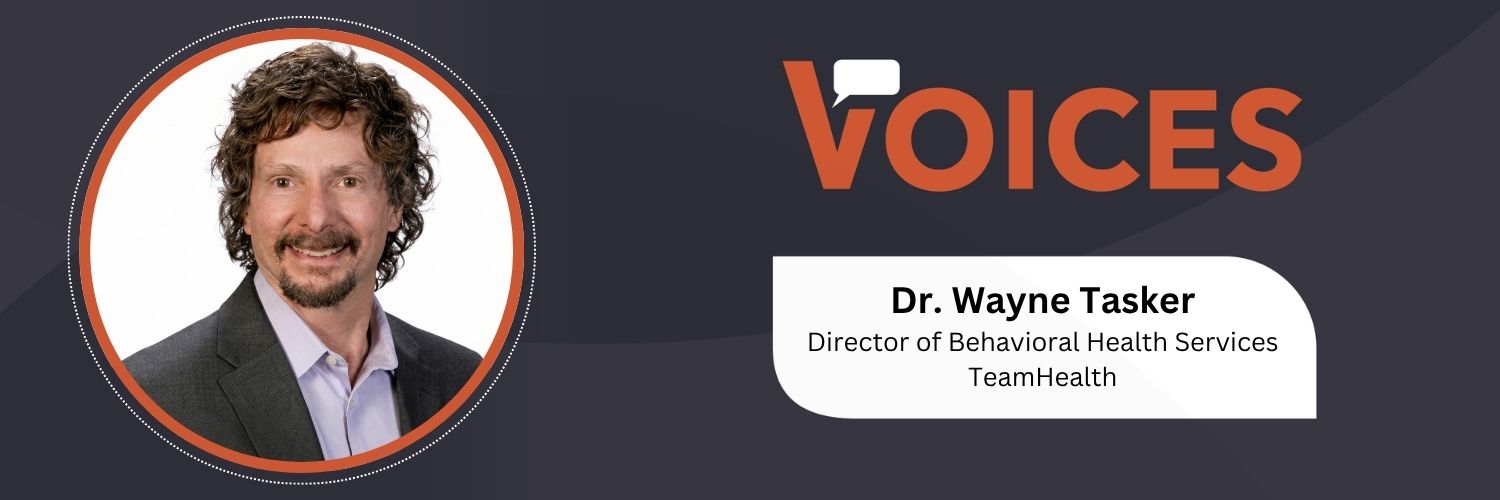


This Voices article is sponsored by TeamHealth. In this Voices interview, TeamHealth Director of Behavioral Health Services Dr. Wayne Tasker shares his journey into behavioral health care and the simple steps he teaches to help all residents with dementia. He explains person-centered dementia care and offers two stories of instances when knowing a resident’s past helped nursing teams quell their anxiety.
Skilled Nursing News: What professional experiences brought you to TeamHealth?
Dr. Wayne Tasker: I have a unique experience. I was working in a small town in Tennessee where I met a psychiatrist whose profession was going into nursing homes. I said, “Nursing homes? What were you doing going to a nursing home?” And he described to me the interactions he had with his residents and what he did and how rewarding it was. I was intrigued by that.
Most of my early career I worked with children and adolescents, and in substance abuse. This, however, was something unique. I’ve always felt that seniors in our country are just ignored. Some seem to think that when you get old, you get useless, but I saw that these people were vibrant. They were alive. They had a lot to offer. That psychiatrist and I built a practice around behavioral health in nursing homes, which was eventually acquired by TeamHealth.
I’ve now had many years in this field and still love the geriatric population. They have the best stories of anybody in the world. If you ever want to get a good story, just talk to them. You’ll love it. That’s how I got into the field and I never left.
From a clinician’s perspective, what does person-centered dementia care truly look like in practice, and why is it so important for patient well-being?
Tasker: This is the most important thing to remember: dementia is just an aspect of a person. Too many times we give a person a label, and we define that person by that label. But every individual is unique and has a unique set of life experiences. One of the problems when you talk about dementia care is that everyone focuses on the deficit — what they can not do now that they could do before. Instead, we should look at what they can still do.
That’s the first step when you talk about well-being. You must talk about what’s still vibrant in them, what they have to offer and how they can still give back to society. They know their deficits. What they don’t remember is the strengths. With dementia care, you want to pull the strengths from those individuals and focus on what they still have to offer. Let’s help them see that just because they may not be the same as they were in the past, they still have coping mechanisms.
What approaches have you seen work best for clinicians and care teams when communicating with patients experiencing cognitive impairment?
Tasker: I do a lot of training in nursing homes and assisted living facilities with the caregiver staff. A simple concept I teach is that communication is everything.
A primary characteristic of dementia is the slowing of the cognitive process. It takes them a bit longer to cognitively catch up when you’re having a conversation. Let’s say a CNA goes into a room and tells the patient, “You need to get up, get out of bed and get in your wheelchair so we can take you to the dining room.” The resident doesn’t respond right off, so the CNA repeats the request. But the problem isn’t that the residents are resistant. They just weren’t given enough time to process the request.
The first step that staff members must take is to allow a 30-second window before they repeat a request. In 30 seconds, the resident can likely catch up cognitively with what is being asked. When you constantly bombard them with the same thing, they get agitated, they get frustrated and things can quickly go downhill.
Second, don’t give three-step commands. Ask one step at a time. “Let’s get you out of bed,” and then we go to the next step. “Let’s get you in your wheelchair.” Otherwise, you’re overwhelming the person’s senses, creating an almost adversarial role with them.
Finally, and this is a big one, something we’re all guilty of in communication: too many times, when we talk to people, we’re not even looking at them. So, I advise care staff to “stop, look and listen.” You stop, have the resident stop, look at each other and actually connect with them. When you do that, they’re more likely to listen. One of the aspects of many people within this population is hearing loss. I can attest to the fact that many times residents are reading your lips. That’s how they communicate. So, if you don’t show them your face, they miss what you’re trying to tell them. These are just small things that can make a large impact.
How can non-pharmacological strategies help manage behavioral and psychological symptoms for patients?
Tasker: “Non-pharmacological” basically means you’re helping them alter their behavior. Caretakers at both home and in facilities are constantly doing non-pharmacological interventions — they redirect residents to move them out of a situation that is uncomfortable, get them a drink of water, maybe a snack or help them go to the bathroom. Those are all non-pharmacological interventions. In those instances, you are paying attention to what the person needs.
When non-pharmacological interventions are successful, residents often have less need for medication. That’s the key. This population is generally on several medications, both medically and psychologically necessary. If we can teach them coping skills, how to manage their behaviors, how to feel more in control of themselves, then we can pull their dependence away from some of the medication. That improves their quality of life, which is a huge win for everyone.
What types of education or preparation help care teams feel more confident caring for patients with cognitive impairment?
Tasker: Education is power. I believe in simple steps for managing people with cognitive behavior, one being that too many times we forget when we have a resident with dementia that this is just one small aspect of their lifespan. The more you know about their past, the more you can help them cognitively.
I knew a man who was very bright and was in the nursing home because of medical conditions. He would get upset and become very difficult to manage at 5 p.m., Monday through Friday. We did some research into his past and found that at 5 p.m., when he got off work, he always had a little glass of sherry. Always. What did we do with that information? We got a little fancy glass, put apple juice in it, gave it to him, and he was happy because we kept his routine.
In another similar instance, a woman would go to the nurses’ station and raise all kinds of ruckus at 3 p.m. Monday through Friday. You could not calm her down. Saturday and Sunday, she was perfect. What’s going on here? We looked at her past and found that Monday through Friday at 3 p.m., she was picking up her kids at the bus stop. She got frustrated because we were keeping her from doing something that she felt like she had to do. It was ingrained in her that she had to go to the bus stop at 3 p.m., “Or nobody’s going to pick up my kids.”
So, every weekday at 15 minutes to 3, we knocked on the door and said, “Guess what? The bus is running late. We’ll come to get you when it’s here.” And 15 minutes later, she had forgotten she even said it. We worked with her instead of challenging her, and then she was fine. She felt relieved.
Why is it important to SNFs to have a therapy program in place to achieve both resident-centered care plan goals and broader quality performance goals?
One of the big initiatives for anybody on psychotropic medications is to put them on the lowest dose possible so that they can function and still have a quality of life. One of the ways you do that is by integrating psychotherapy and counseling into their program. If you try to reduce a medication but you don’t teach that person coping skills, you’re going to go right back to that medication.
That’s the value of therapy: it teaches people coping skills, how to manage their behaviors and feelings and not be so dependent on medication. Medication serves a purpose and is definitely important, but it should be a stabilizer. If we can help someone learn to manage things themselves, that gives them more independence and a sense of control over their life.
That’s why you see this big push from CMS — and it’s a good thing — saying, “What are you doing before you give them a pill? What have you tried? Have you even talked to the person?” A therapy program is probably the best non-pharmacological intervention there is. Something that mimics dementia a lot is major depression. When someone has major depression, it dulls the senses. It dulls their ability to cognitively work like dementia does. Sometimes when you treat depression, you find that the person didn’t have dementia in the first place.
Finish this statement: “In post-acute behavioral health care, 2026 will be the year of…”?
Tasker: Understanding and acceptance.
TeamHealth partners with facilities nationwide to deliver compassionate behavioral health care. Our scalable clinical and operational models are designed to meet the unique needs of each organization while helping to improve access, outcomes and continuity of care. To learn more, visit www.teamhealth.com/behavioral-health.
